White Papers
There are a number of key areas within the healthcare field that require additional focus and attention in order to standardize hospital design.
This is a very exciting time in the healthcare field. Many provinces, states, and countries are in the process of designing and building new acute care (hospital) facilities. There is an opportunity to share best practices and exceptional design and clinical flow with many stakeholders throughout the world.
This proposal outlines a number of areas and opportunities that could be developed and shared with stakeholders throughout the world.
The main objective would be to create a Centre of Excellence with the University of Victoria and University of Calgary that would focus their attention toward the following key areas of interest.
PPP Project Agreement Direction and proposed suggestion
- Develop a list of standardized Mock Up rooms that could be used across the provinces and with our partners based on the level of acute care.
- Examples of the direction provided in a PPP Project Agreement to ProjectCo:
- Operating Room
- Psychiatry In Patient Unit
- Recovery Room
- IPU with bathroom
- Lab Bench
- Medication Room
- Clean/Soiled Room
- Labour Delivery Recovery Post-Partum Room (LDRP)
- Emergency Department – Patient Room
- Intensive Care Unit
- Endoscopy/Procedure Room
During Construction, Project Co will construct an in-situ "prototype" of each of the following rooms and make each prototype available to the Authority at appropriate stages of construction so that the Authority and the User Consultation Group can review the prototype room (including all materials, services, millwork, finishes, equipment and furniture) in its actual location within the Facility at various stages of construction, and consider whether any design adjustments are necessary:
The Mock-Up Room concept utilizes 4 levels of design including:
- Taped rooms
- Card board facsimile rooms
- 3D Renderings
- Full scale rooms including all furnishings, fixtures, clinical equipment, wall coverings, etc.
Project Co will undertake the Design utilizing a fully integrated, three-dimensional, real-time dynamic building information modeling ("BIM") capable software solution that needs the requirements set out in this Section.
- BIM Platform. Project Co will use a BIM platform that:
- is a relational database with object-orientated capabilities;
- is capable of three dimensional (3D) parametric modeling;
- is fully integrated to support all design disciplines;
- supports data attributes associated with objects
- allows exchange of information between the component parties and other software solutions utilizing industry foundation classes (IFC).
- Visualization. The Authority's goal in requiring BIM is to help with providing clarity during the Design so that the communications of ideas, particularly to those groups not familiar with interpreting two dimensional drawings, is enhanced. Accordingly, Project Co will:
- use an active 3D model for all designs, user group meetings (in addition to paper documents); and
- use colour to distinguish, zones, ratings, systems, etc. to support the communication of the design and provide clarity of intent;
- Transition Planning and Training
- Work schedules and templates to be shared in the future
- Lessons learned associated with educating and training our clinical and non-clinical teams prior to move into new facilities
- Clinical Flow
- Equipment Use and placement
- Soiled and Clean Rooms
- RFID and RTLS systems
- Process Flow
- Communication Systems (Vocera)
- Patient Wandering Systems
- Effective utilization and knowledge of all systems enabling the most enhanced care to the bedside
In order to enhance the existing RFP Evaluation process an additional evaluation component referred to as Scored Elements has been developed for the North Island Hospitals Project (NIHP) and Children’s and Women’s (CW). Previous work on Scored Elements was conducted on the Interior Heart and Surgical (IHS) project in Kelowna.
This Quantitative and Qualitative Process pushes the consortiums or proponents to better meet the needs of the health authority by measuring specific pre-defined performance measurements during the RFP Stage of the Procurement Process as outlined below. By providing the proponents with these performance measurements the proponents are required to greatly enhance their designs in an effort to obtain additional points that are eventually calibrated into $$ savings to their Financial Submissions. On the NIHP the proponents have an opportunity to reduce their Affordability submission hypothetically by $43 million dollars.
Computerized modelling sequences the permutations and combinations in order to identify and codify any calculations based on the predetermined design criteria.
Some of the objectives and outcomes are outlined below.
In addition, Compliance based Evidence Based Design is also incorporated into the RFP evaluation process
| Project Objectives Simplified | Measureable Outcomes |
|---|---|
| Improve Health Outcomes | Reduced Adverse Events (AE) Reduced Hospital Acquired Infection (HAI) Reduce Length of Stay (LOS) Reduced patient falls |
| Attractive, Healthy, and Safe Workplace | Reduce staff health claims Reduce turn over / recruitment costs |
| Increase Operational Efficiency | Reduce staff overtime Travel and Corridor Efficiencies |
| Elderly Friendly and Culturally Sensitive Design | Staff retention Improved Health Outcomes |
| Quantitative | Qualitative |
|---|---|
| Natural Light | Building Interior Design |
| Travel Distance / Corridor Efficiency | Confidentiality and Privacy |
| Component Layout, Process Flow | Views |
| Standardization | Building and Site Efficiency |
| Separation of Flows | Ease of Expansion |
| Line of Sight | Landscape |
| No. | Qualitative Element | Measurable Outcomes |
|---|---|---|
| 1 | Building Interior Design Interior of the building promotes a healthy and healing environment; respecting the Elderly Friendly principle and the cultural community | Lower patient & staff stress levels, provide positive distractions, improve health outcomes, and improve staff retention. |
| 2 | Confidentiality & Privacy The building respects the dignity of patients and allows for appropriate levels of privacy and confidentiality. | Improved health outcomes, improve staff satisfaction and retention rates, improve patient and family satisfaction. |
| 3 | Views There are real views to nature from the inside to the outside of the building. Orientation of the building on the site should maximize views. | Promote a health healing environment, promotes healing and decreases stress for patients, decreases stress for staff. |
| 4 | Building and Site Efficiency The site master plan maximizes efficient travel distances and routes to create effective functional relationships among the buildings and the site. | Site efficiency over the long term, patient and visitor travel distances are minimized, increases satisfaction and lowers stress, minimize traffic and pedestrian risks. |
| 5 | Ease of Expansion The site master plan is designed to facilitate future expansion plans. | Increase Operational Efficiency, site design facilitates future site expansion plans. |
| 6 | Landscaping The landscape around the building contributes to a healing environment, contributes positively to the locality, and is sensitive to the cultural community. | Reduces patient and staff stress levels; improved health outcomes; provides positive distraction for patients, families, and staff. |
| EBD Features | Compliance / Scored | Source |
|---|---|---|
| Single patient rooms w/ private bathrooms | Compliance | Clinical Specs |
| Number and location of handwashing sinks | Compliance | Clinical (location), and Technical (No) |
| Very good air quality (i.e. HEPA Filters) | Compliance | Technical Specs |
| Single patient rooms design with good visual access | Compliance / Scored | Clinical (Design) and Scored |
| Ceiling Mounted Lifts | Compliance | Technical Specs |
| Bathroom located on headwall | Compliance | Clinical Specs |
| Single room support family stay | Compliance | Clinical Specs |
| Siting of Building promote access to natural light | Compliance | Technical Specs |
| Noise reducing measures | Compliance / Scored | Technical Specs and Scored (Qualitative) |
| Visual Distractions | Compliance / Scored | Technical Specs, Scored (Natural Light), Scored (Qualitative) |
| Shorter travelling times | Compliance / Scored | TClinical Specs and Scored (Travel Distances) |
| Bright task lighting (i.e. medication rooms) | Compliance | Clinical Specs |
| Garden access, comfortable staff respite area, nursing unit floor layout that reduce walking, fatigue, and stress. | Compliance / Scored | Clinical specs, Scored (Travel Distance), and Scored (Qualitative) |
Scored Elements Research Proposal:
RKL Consulting (see attached proposal) to carry out extensive research over a 3 - 5 year period to validate the Scored Elements Measured Outcomes during the operational period of large infrastructure projects including NIHP, CW, and IHS.
This research would help validate the Scored Elements initiative and its performance measured outcomes assisting Politicians and the senior health authority executive in better understanding and showcasing the benefits of applying the Scored Elements measurements during the RFP stage of the project.
IMIT is notoriously an extremely difficult area to develop, implement, and manage.
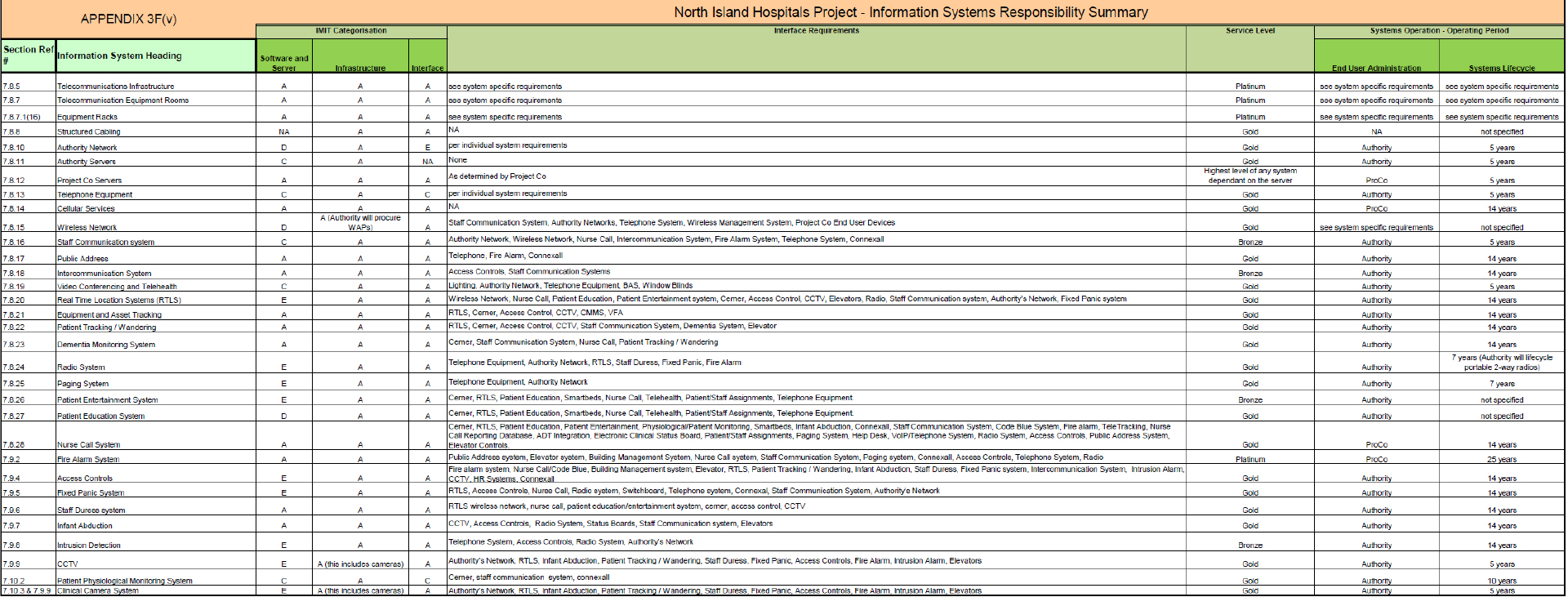
We have created a Responsibility Matrix that assists all stakeholders in better understanding the many responsibility areas associated with purchasing, installing, certifying, managing and maintaining, and most importantly dealing with Lifecycle Management associated with all IMIT systems and infrastructure associated with this project.
Additional work and referencing of this material for future projects.
A brief glimpse of this extensive spreadsheet is outlined below:
British Columbia is moving forward in an effort to place more focus and emphasis on healthcare in the home. We are working towards developing a vision of what that might look like.
Our project is acting as a catalyst to demonstrate Cerner – Smart Technology in an acute care facility in British Columbia. We are working with the communities across north Vancouver Island to help address this new focus and objective.
University of Victoria and University of Calgary – Environmental Design to conduct research and develop white papers showcasing the benefits of implementing Primary Healthcare.
Extensive healthcare networks across Yukon, British Columbia and Alberta are being developed and enhanced in an effort to share lessons learned on all existing and new projects with stakeholders.
The objective is to develop a Tri-partite team participating in the sharing and development of a reference portal able to provide information to interested stakeholders.
Developing a new web-site where much of this reference information could be stored for specific provinces, states, and countries in an effort to share the referenced information that will be developed in the future.
In order to reduce design replication of costs it would be extremely useful to develop a reference package that would assist the user in providing standardization of base design methodology. Recognizing that we will continue to enhance design standardization would support a foundation towards base build growth and development providing the user with a base design to design and build from.
Standardization could be based on size of the facility and location of the acute care facility ie. High Populations; Urban; Rural; or Isolated.
Examples could include:
| High Population Base: Urban: | Vancouver, Calgary, Edmonton, Kelowna, Prince George, Red Deer, Grande Prairie, Lethbridge |
| Semi-Rural: | Nanaimo, Duncan, Edson, Fort McMurray, Whitehorse |
| Rural: | Courtenay, Campbell River, Canmore, Olds, Didsbury, Dawson City, Watson Lake |
- Operating Room
- In Patient Unit (IPU)
- Head Wall
- Intensive Care Unit (ICU)
- Labour Delivery Recover Post-Partum (LDRP) Room
- Clean/Soiled Room
- Emergency Rooms
- Trauma Rooms
- Clinical Decision Unit Rooms (CDU)
- Cast Room
- Treatment Cubicle
- Emerg/Urgent Treatment Cubicle
- Laboratory
- Pharmacy
- The BC Provincial Government is extremely interested in enhancing these programs from Acute Care Facility’s to the home.
- A white paper to be developed outlining this proposal, opportunities and benefits.
- Community engagement is critical to the success of all large infrastructure projects.
- Map out the various steps and action items associated with a successful community based engagement.
- Examples to include Fort St. John, North Island Hospitals Project, etc
- SIM Labs are being designed and incorporated into most of our urban and rural facilities in British Columbia
- These rooms are usually incorporated into the UBC Residence Program that has been successful throughout BC.
- The SIM Labs are used by many clinical users including medical residents, existing physicians and nurses, nursing program, paramedics, and other healthcare related specialties.
- The level or complexity of the SIM Lab is based on the level of acuity in the facility.
- The CESEI Program is one of the leaders in SIM technology in North America
- A site tour of this facility at Vancouver General Hospital can be arranged at your convenience.
- Contact Person:
- IT Manager:
Mr. Ferooz Sekandarpoor
Phone: (604) 875-4111 x 66554
Email: ferooz@cesei.org
- IT Manager:
Interested in learning more about how PMPSL can help your project?
Contact Us